
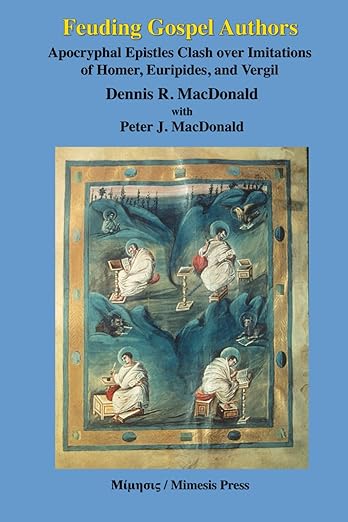
Feuding Gospel Authors by Dennis R. MacDonald
$19.99
Feuding Gospel Authors consists of letters exchanged by the authors of Mark, Matthew, Luke, and a lost Gospel reconstructed as The Logoi of Jesus (Q+). Whereas MacDonald’s previous books explored how the evangelists imitated Greek poetry, these epistles reveal why.
Description
Feuding Gospel Authors consists of letters exchanged by the authors of Mark, Matthew, Luke, and a lost Gospel reconstructed as The Logoi of Jesus (Q+). Whereas MacDonald’s previous books explored how the evangelists imitated Greek poetry, these epistles reveal why.
The Introduction explores Mark’s imitation of Polyphemus in the Odyssey. Here and elsewhere, he targeted Homeric tales to rival Vergil’s imitations in the Aeneid. MacDonald then explains the criteria of Mimesis Criticism designed to detect literary imitations. Jesus was mythologized, but he himself was not a myth.
Skeptics often dismiss Mimesis Criticism as ‘parallelomania,’ but ancient readers were parallelomaniacs who relished clever imitations. Such critics, on the other hand, suffer from Homerophobia. Feuding Gospel Authors offers a remedy: a paradigm shift in understanding the Gospels, the historical Jesus, and Christian theology.
Some Highlights
• The author of Logoi (Q+) tells Mark that he regrets his Jesus’s threat to destroy the temple after his postmortem return—Roman legions had proved him wrong—but he defends his forgiveness of an unrepentant sinful woman. He resented Matthew’s omission of this story and his insistence on strict Torah-compliance. Luke, on the other hand, replaced Logoi’s story with one about an extravagantly repentant prostitute.
• Mark tells the author of Logoi that he inherited no other sources about Jesus. For composing his founding myth, he imitated Homer to make Jesus more powerful and compassionate than Homer’s heroes as well as Vergil’s Aeneas. Mark’s biggest complaint against Matthew was his rewriting of his miracle stories to remove the most obvious similarities with Greek poetry. Mark wrote a founding myth; Matthew wrote a credulous biography.
• Matthew, in turn, objected to Mark’s negative portrayals of the Twelve that he created by imitating Odysseus’s cowardly comrades at sea and unfaithful slaves at home. Matthew thus repeatedly exculpated Peter and created Judas’s suicide as a demonstration of remorse. It was the chief priests who were to blame for Jesus’s death, not he.
• Luke strongly objected to the endings of both Mark and Matthew and set out to improve them by imitating last book of the Odyssey. Just as Odysseus proved his identity by baring his childhood scar, Jesus proved his by baring his wounds from the cross.
• Luke also reveals for Theophilos that he had read sections of Josephus’s Antiquities, but the copy he consulted had an episode about Jesus that had been nearly entirely scraped away by a Christian. From the surrounding stories, however, Luke concluded that the historian must have blamed Jesus for a Jewish insurrection that led to his crucifixion by Pilate. To correct this impression, Luke after imitated Plato’s depiction of Socrates’ unjust execution in his narratives about Jesus’s trial before Pilate, his crucifixion, and Paul’s apologia. In Acts, Paul is a new Socrates, a new Dionysus, a new Odysseus, and a rival to Aeneas.
Only logged in customers who have purchased this product may leave a review.
Related products
-

Doctrine Made Flesh: Faith and the Grammar of Love by K. Steve McCormick
$15.99 Add to cart -

Theological Education in 2050: AI, Ministry, and the Future of Formation by Heather Shellabarger
$15.99 Add to cart -
Introduction to the Letter to the Hebrews by David Young
$15.99 Add to cart -

AI and Theological Pedagogy: A Bloom’s Taxonomy Approach for Graduate Seminaries by Heather Shellabarger
$15.99 Add to cart
Reviews
There are no reviews yet.